
4 Elements
Sanctuary
Bocas del Toro · Panama
Water
Earth
Air
Fire
Scroll
Four elements.
One sanctuary.
A boutique floating and rainforest resort on the protected side of the Bocas del Toro archipelago — designed so that Water, Earth, Air and Fire are felt across every part of the property.
Every stay here begins on the water or in the rainforest. The elements are the structure of the guest's day — where they wake, whether they walk or swim, where they gather, and what happens when the light goes.

Wake with the water.
Set within a serene jungle canal, the Marea casitas float — moving gently with the tide, with the water directly beneath you and rainforest on both banks.
Floor-to-ceiling views down the canal. A private deck at the waterline. Open-air living behind hardwood louvres that fold back to the breeze. Lantern light on the water after dark, and mornings so still the reflection holds.
The canal is what makes this work. Sheltered, protected water with rainforest on either side — calm enough for a floating structure to sit comfortably year-round, and private in a way an open bay can never be.
A floating unit is built off-site, delivered finished, and moored rather than founded. Capacity can be added one casita at a time as demand proves out, units can be repositioned, and the asset is not permanently sunk into a single spot on the seabed.


Live within the rainforest.
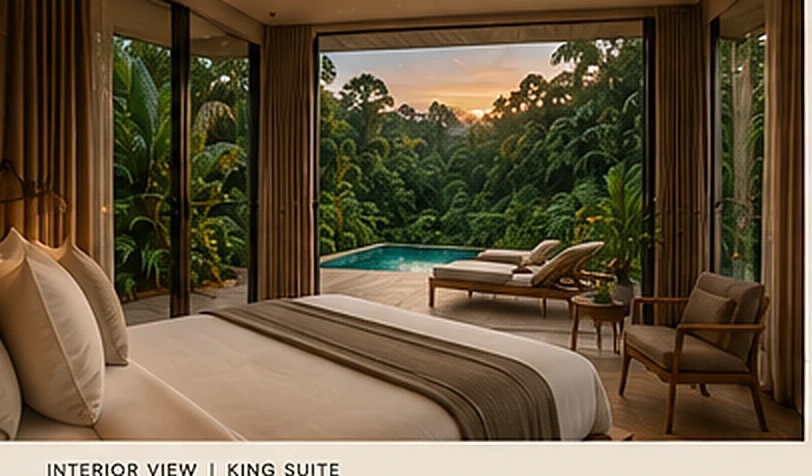
This is where the rainforest becomes part of the architecture. Bungalows staggered naturally across the gradual slope, surrounded by palms, tropical planting, stone paths and dense vegetation.
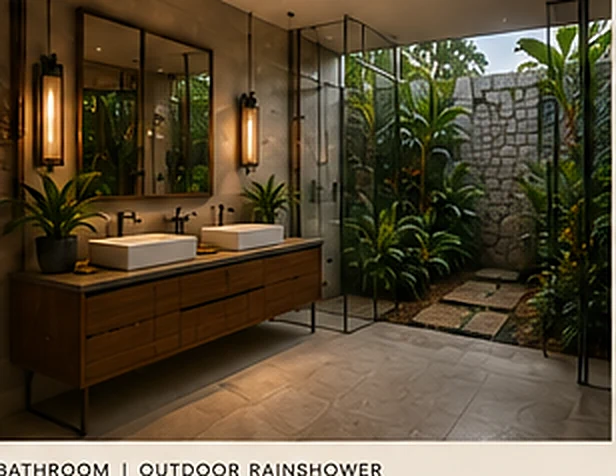
Hardwood, concrete, natural stone and black metal ground the buildings into the landscape rather than sitting on top of it. Each has its own plunge pool and outdoor living space, with dense planting holding the privacy between them.


Gather in the open air.
Candela – Pavilion & Restaurant — the flame, and the light it throws. It is the architectural heart of the sanctuary: open, elevated and breezy, under a large overhanging roof with massive openings that hold the breeze and the rainforest right at the edge of the room.
Indoor–outdoor bar and lounge. Dining. Gathering areas. Yoga and wellness space. The pool runs the full length in front, and stone steps drop from the deck straight to the water.
It sits apart from the accommodation by design. Guests come down to it, or arrive at it by boat, and leave their bungalow behind when they do — which is what keeps Terra and Marea private while everything social happens here.
There are no walls to close. The roof gives the shade, the openings give the breeze, and the water sits below the deck — so the room is never quite a room. Shelter without enclosure, which in this climate is the only kind worth building.
Candela – Pavilion & Restaurant is being developed at a larger footprint than the current massing shows. Food, beverage, wellness and events all earn here, which makes it the part of the property that generates revenue beyond the room rate.
A single material language runs through both bungalow types, Candela – Pavilion & Restaurant, and the landscape.

Before the property, the place. Panama is the easiest country in the region for a North American or European to own in, get to, and be paid in.
Sources: Panama Canal Authority FY2025 · Superintendencia de Bancos de Panamá · Ministerio de Economía y Finanzas · PwC Worldwide Tax Summaries · World Bank ThinkHazard · US State Department.
Every figure below is drawn from Panamanian government or official promotion-agency data and linked to its source. Where the data does not exist, we say so rather than estimate.
In 2026 measurement, Bocas del Toro records the highest hotel occupancy of any measured destination in the country — ahead of Panama City (67%), other provinces (63.9%) and Chiriquí (57.7%), against a national average of 66%. This is the single strongest data point in the thesis: the market is supply-constrained, not demand-constrained.
Caveat we are not hiding: the measurement panel expanded from 53 to 146 properties from July 2025, so the year-on-year comparison is not like-for-like, and Bocas only recently became separately reportable. Source data is PROMTUR via CoStar/STR, reaching us through press reporting rather than a retrievable PROMTUR release.
Panama's first year above three million visitors, and the highest on record — 19.8% above pre-pandemic 2019 on total visitors and 32.0% above on overnight tourists. The first half of 2026 ran 17.4% ahead of the same period in 2025 at 1.75 million visitors, with national hotel occupancy at 67.6%.
Bocas del Toro "Isla Colón" airport (BOC) is served daily from Panama City Albrook (PAC) — approximately 62 flights per week, averaging nine a day, roughly one hour's flying time — plus Sansa service from San José, Costa Rica. Total inbound movements run around 287 a month.
Stated plainly: there is no service from Tocumen (PTY). North American and European arrivals connect through Albrook, a different airport across the city. This friction is real, it is currently a barrier to the highest-spending guest, and it is also precisely why the market is under-supplied at the luxury end.
Panama's Autoridad Aeronáutica Civil has a US$20 million tender at homologation stage for Isla Colón: a new 4,000 m² terminal handling roughly three times current simultaneous passengers, the runway widened from 25 m to 30 m with a 160 m extension, structural reinforcement, new taxiways, expanded apron, fuel storage and approach lighting. Eight bidders. Twenty-four months from work order.
The published scope reinforces the runway for Fokker 50 and Dash 8 Q400 turboprop service and roughly triples terminal capacity — a bigger, more resilient version of the access that already exists, rather than a jet gateway. It remains at tender: the contract is yet to be awarded and the Category III environmental assessment is still to be completed, so we underwrite on today's access and treat the upgrade as upside.
Hospital Guillermo Sánchez Borbón sits on Isla Colón, the same island as Bocas town. Sixty-four beds — 44 hospitalisation, 20 observation — on a five-hectare site, with emergency, general and internal medicine, paediatrics, gynaecology and obstetrics with two delivery rooms, an operating theatre, orthopaedics, twenty consulting rooms, physiotherapy, dentistry, laboratory, imaging and pharmacy. It serves a catchment the government puts at over 125,000 people, plus visitors.
It replaced the province's original hospital, a building dating from the 1930s. For a remote island destination, moving from that to a purpose-built modern facility on-island is the single most meaningful infrastructure change of the past decade — and it removes a question that otherwise sits over every high-end guest and every prospective owner.
Stated accurately: this hospital was inaugurated in June 2019 and began attending patients in January 2020. It is established, not new. We have found no verified intensive care unit, dialysis, CT or MRI on Isla Colón, and specialist surgery has been documented as a scheduled monthly service rather than a continuous one.
The province's higher-acuity capacity sits on the mainland, under the Caja de Seguro Social. The Hospital Dr. Raúl Dávila Mena in Changuinola opened the province's first intensive care unit in July 2024 and added a four-bed special care unit with ventilators and continuous dialysis in January 2026. The Hospital de Almirante, a US$41.5M, 50-bed facility with three operating theatres and CT and MRI imaging, was inaugurated in January 2024.
Both are genuine upgrades and both are recent. Neither is on the islands — there is no road or bridge from Isla Colón, so reaching either means a water crossing followed by road travel. We are not going to present mainland capacity as if it were on the doorstep.
Panama's tourism authority publishes arrivals by port of entry and source market, not by domestic destination. No province-level visitor figure for Bocas del Toro exists in any ATP dataset, including the 2025 annual report. Any Bocas "visitor number" circulating in market materials is an estimate. We do not publish one.
The capital being raised builds, opens and stabilises the resort.
This is two separate raises on separate terms, not one. The tabs below switch between them — each has its own raise target, nightly rates, hold and pro forma.
| Occupancy | 50% | 60% | 70% | 80% |
|---|---|---|---|---|
| Nights let | 180 | 216 | 252 | 288 |
| Annual revenue | $459,000 | $550,800 | $642,600 | $734,400 |
| Operating expenses | $187,800 | $213,360 | $238,920 | $264,480 |
| Net operating income | $271,200 | $337,440 | $403,680 | $469,920 |
| Cash-on-cash return | 11.3% | 14.1% | 16.8% | 19.6% |
| Value at an 8% cap | $3.39M | $4.22M | $5.05M | $5.87M |
Eight keys trading — 2 – Floating Casitas and 6 – Rainforest Bungalows — let directly, with boat tours and excursions. Occupancy is applied to a 360-night year. Operating expenses are stated all-in: staffing, boat running costs and a management fee at 20% of gross receipts, which together run at US$710 per operating night, plus US$60,000 of annual fixed costs covering insurance, property and corporate taxes, accounting and legal, utilities, maintenance and capital reserve, and a miscellaneous line. Net operating income is stated before Panamanian corporate income tax at 25% and before ITBMS, which applies to lodging at 10% and is passed on to the guest. Cash-on-cash return is net operating income over the US$2.4 million deployed. The 8% capitalisation rate is an assumption rather than a quoted market rate — Bocas del Toro has no published hotel transaction comparables, so nightly rates are set against local market conditions.
| Occupancy | 50% | 60% | 70% | 80% |
|---|---|---|---|---|
| Nights let | 180 | 216 | 252 | 288 |
| Annual revenue | $1,368,000 | $1,641,600 | $1,915,200 | $2,188,800 |
| Operating expenses | $552,000 | $645,600 | $739,200 | $832,800 |
| Net operating income | $816,000 | $996,000 | $1,176,000 | $1,356,000 |
| Cash-on-cash return | 20.4% | 24.9% | 29.4% | 33.9% |
| Resort value at an 8% capwithin three years of Phase Two completion | $10.20M | $12.45M | $14.70M | $16.95M |
Fifteen keys trading — 6 – Floating Casitas, 6 – Rainforest Bungalows and 3 Family Cabins — with Candela – Pavilion & Restaurant open for food, beverage, wellness and events. Nightly rates step up by approximately 20% across the board, because the property is no longer a direct Airbnb let but a fully operational resort: US$275 Marea – Floating Casitas, US$325 Terra – Rainforest Bungalows and US$400 Family Cabins, alongside boat tours and excursions and food and beverage. Occupancy is applied to a 360-night year. Operating expenses are stated all-in: staffing, boat running costs, food and beverage cost of sales and the management fee, which together run at US$2,600 per operating night, plus US$84,000 of annual fixed costs covering insurance, property and corporate taxes, accounting and legal, utilities, maintenance and capital reserve, and a miscellaneous line. Net operating income is stated before Panamanian corporate income tax at 25% and before ITBMS, which applies to lodging at 10% and is passed on to the guest. Cash-on-cash return is net operating income over the US$4.0 million deployed across both phases. The 8% capitalisation rate is an assumption rather than a quoted market rate — Bocas del Toro has no published hotel transaction comparables, so nightly rates are set against local market conditions.
Phase One and Phase Two are separate raises on separate terms. A full financial model, capital stack, construction budget and sensitivity analysis are released to qualified investors under NDA in the Accredited Investor Packet. Nothing on this page should be viewed as an offer, and should be looked at as best estimates only, but not a guarantee of its performance.
Built in stages so that early phases can trade and generate revenue while later phases are under construction.
Eight keys let out directly through Airbnb while the rest of the site is developed — the units earn from the moment they are finished, with no food and beverage operation and no payroll to carry. The booking history they generate becomes the evidence base that prices Phase Two.
Candela – Pavilion & Restaurant is built once there are enough keys to fill it, against occupancy and rate already proven on the ground. That is the point the property stops being a set of rentals and becomes a resort — and it is where food, beverage, wellness and events revenue begins.
Bocas del Toro has a reputation for messy land. That reputation is earned, and it is the reason a clean position is worth so much here.
There is no general nationality restriction on owning titled real property in Panama, in a personal name or through a corporation. Two constitutional restrictions apply: foreign governments and official entities may not acquire territory (Art. 290), and no foreign person — nor any Panamanian company with foreign capital — may own land within 10 km of a national border (Art. 291). The Costa Rica border runs through mainland Bocas del Toro province, so the 10 km line must be checked against any specific parcel; note that Art. 291 pierces the corporate veil, so a Panamanian company does not cure it.
Panamanian coastal and island land falls into three very different categories, and they are routinely conflated in marketing. Titled property is registered fee ownership with a finca number in the Public Registry — mortgageable, and not extinguishable by the State except by compensated expropriation. Rights of Possession are a possessory interest in land the State still owns; unregistered, generally unfinanceable, and convertible to title only if the parcel clears the exclusions in Ley 80 de 2009. Concessions are time-limited State grants — 20 years, renewable, over strategic island areas.
Ley 80 also puts hard limits on what can ever be titled: mangrove zones, indigenous and comarcal territories, and protected areas are excluded outright, and on the Caribbean side the first 10 m from the high-tide line is public domain. Any investor in this region should ask for a finca number and a registry certificate before anything else.
Every parcel in this development is titled property, registered in the Panamanian Public Registry. None of it is held as Rights of Possession, and none of it sits on a concession. It is owned outright by the development entity, free to be mortgaged, transferred and insured like any other registered real estate.
That is the difference between this and most of what trades on the water in Bocas del Toro — a registered title, rather than a possessory claim that may or may not survive scrutiny.
The site is a three-lot assembly. Two lots are contributed to the project by the partner rather than bought with raised capital; the third is acquired in Phase One. All three are titled.
Registry particulars, the ownership entity, the cadastral plan and the boundary survey are provided to qualified investors in the data room.
Finca number to be published here
Panamanian corporate income tax is a flat 25%. Where taxable income exceeds US$1.5 million, an alternative minimum applies — the greater of the standard calculation or 4.67% of gross taxable income — which matters for a resort in its early trading years, because it can produce tax on gross revenue before net profitability. ITBMS (VAT) is 7% generally, but lodging in all its forms is taxed at 10%, and alcoholic beverages at 10%.
Panama taxes on a territorial basis under Fiscal Code Art. 694 — but that is a source rule, not a residence rule. A resort operating in Bocas del Toro earns Panamanian-source income. Territoriality provides no shelter for resort revenue and we do not present it as a benefit.
This is where most Panamanian resort pitches overclaim, so we will be blunt. The fiscal-credit regime under Laws 122 of 2019 and 314 of 2022 was constitutionally challenged and expired on 31 December 2024. The Law 80 of 2012 incentive window was stated by the tourism authority to run only to 31 December 2025, and we found no evidence of an extension. The authority has expressly ruled out reinstating fiscal credits. In July 2026 the government announced an intention to introduce new tourism incentive legislation; no bill has been published and no terms are known.
Our model does not assume any tax incentive. If a new regime arrives, it is upside we have not underwritten.
Panama's Qualified Investor Visa (Executive Decree 722 of 2020, as amended by Decrees 109 of 2022 and 193 of 2024) grants permanent residency against four defined routes: titled real estate, an irrevocable promise-to-purchase on a project under execution, securities acquired through a Panama-licensed brokerage, or a bank time deposit. Subscribing for equity in a private development company is not one of them. We have found no source, government or professional, supporting a private-equity route, and we will not suggest one.
Where an investor wants residency alongside the investment, the route with actual support is taking title to a qualifying unit — including through a corporation of which the investor is the registered ultimate beneficial owner, which Decree 193 expressly permits. That is a different structure and can be discussed. The minimum was US$300,000 as at August 2026, but practitioner sources directly conflict on whether a scheduled increase to US$500,000 takes effect on 15 October 2026, and Law 492 of 2025 may bear on the programme in ways we could not verify. No figure here should be relied on without Panamanian immigration counsel.
Every one of these is real. Presented here rather than discovered in diligence.
A banana-sector strike over national pension reform escalated through 2025 into road blockades and airport disruption. Cabinet Decree 27 of 20 June 2025 declared a state of urgency across Bocas del Toro province and suspended constitutional guarantees including habeas corpus and freedom of movement. Local hoteliers reported occupancy falling to around 20%.
Effectively all air access runs through one small airport served by turboprops from Albrook, plus limited service from San José. There is no jet service and no Tocumen connection. Disruption at BOC, or at Albrook, is disruption to the entire guest pipeline.
The tourism tax incentives many Panamanian resort projects have historically relied on are not currently available to new applicants, and the replacement legislation announced in July 2026 has not been introduced.
The Marea casitas float and are moored rather than founded on the seabed, which removes most of the piling, marine-works and cost-inflation risk a fixed overwater structure carries. It does not remove the regulatory question: occupying water in Panama engages a different consent regime from building on titled land, and the applicable basis for moored accommodation has to be established with Panamanian counsel rather than assumed.
The island hospital covers emergency, surgery and maternity, but higher-acuity care is on the mainland across a water crossing. We could not verify a hyperbaric chamber anywhere in the province — relevant in a diving destination — and the nearest one we could identify is a private facility in David, Chiriquí, with posted weekday hours rather than round-the-clock emergency cover. Air ambulance capability exists through the national aeronaval service but is not stationed in Bocas del Toro.
Once taxable income passes US$1.5 million, Panama's alternative minimum calculation can tax 4.67% of gross taxable income regardless of net position — a real drag in early trading years.
Western Panama sits on the North Panama Deformed Belt. The Limón earthquake of 22 April 1991, magnitude 7.6, killed 79 people in Bocas del Toro and damaged Guabito, Changuinola, Almirante and Isla Colón. The World Bank's ThinkHazard rates earthquake hazard in Bocas del Toro as high — better than a one-in-five chance of potentially damaging shaking over fifty years — and states that it must be accounted for in design and construction.
A single boutique asset in a frontier market has a thin buyer pool at exit. Bocas has no institutional hotel transaction comparables to price against.
The full financial model, capital stack, construction budget, registry documentation and phasing programme are released to qualified investors in the Accredited Investor Packet.
If you would rather talk before reading anything, say so in the message and we will arrange a call.